


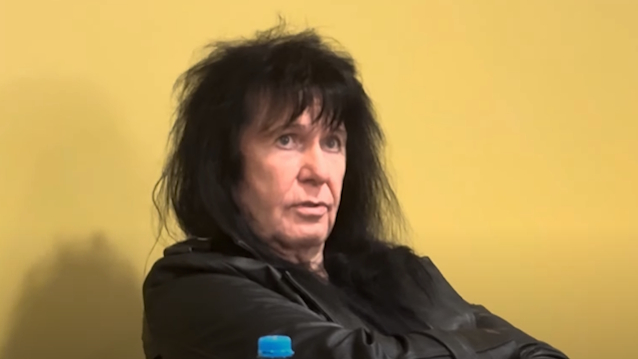
W.A.S.P.'s BLACKIE LAWLESS Reflects On Time He Ruptured Left Side Of His Voice: 'It Was Terrifying To Go Through'
October 5, 2025During a "VIP Experience" question-and-answer session before W.A.S.P.'s September 30 concert in Utrecht, The Netherlands, W.A.S.P. mainman Blackie Lawless was asked if his singing voice is his "natural voice", considering the tone of his speaking voice is less "screamy" than how it comes across when he is performing live. Blackie responded (as transcribed by BLABBERMOUTH.NET): "Well, some singers sound exactly like they talk; some don't. I'm one of those guys that doesn't sound like they talk. I also think a lot of what we do in the in rock the rock community — lead singers are actors. We act out the lyrics. [IRON MAIDEN's] Bruce Dickinson does it. [METALLICA's James] Hetfield does it. I do it. A lot of guys do it. And we look at the lyrics like it's a one-man play. And so when you're writing the lyrics, you're envisioning how you're gonna deliver them. I'll give you an example, and I've used this example before, but it'll make sense to you. When I was doing 'The [Crimson] Idol', in 'Chainsaw Charlie' there's a line in that says, 'Welcome to the morgue, boy.' And when I wrote that line, I knew exactly how I wanted to deliver it. I heard it in my head, I saw it, I knew exactly what I wanted it to be. And when it [came] time to actually sing it, the first couple of times I tried it, it didn't sound anything like I heard it in my head. So I kept working on and working on it until I got it to sound exactly the way I had envisioned it. So, like I said, there's a lot of acting that goes on with that. So I think anybody that acts out lyrics, they're probably — especially when you mentioned the screaming portion of it, when you start getting really loud, it starts to change the timber of your voice and the way you sound. And that's for everyone, because most of the guys I know that sing rock, they don't sound the same when they talk, because, again, they're singing loudly, they're acting, so that changes a lot. The country western guys, they don't sing very loud, so they sound a lot like they do when they talk. It's a melodic extension of their natural voice. But rock singers, it's pretty different 'cause it's a lot louder."
Asked if he ever had any voice problems over the decades, Blackie said: "Oh, yeah. I had a huge problem. In '83, before our first record came out, I ruptured the left side of my voice. And there was a flu going around — it was a viral laryngitis — and everyone that got it couldn't speak… I got it, but I didn't sound [hoarse] when I talked because [after] all the years of singing, my muscle and my throat, or my voice, was more developed than other people, so I could talk and I sounded okay, even though I was ill. But I went into rehearsal one day and I tried to sing, and I wasn't getting loose. And I kept cracking while I was singing. And I thought, 'Well, I just need to get a little loose.' And I kept pushing and pushing and pushing. And finally about 30 minutes into it, I couldn't speak. And that went on for about three days — I couldn't speak. And I thought, 'Well, I'd better go see a doctor.' So there's a voice specialist. His name was Ed Kantor. He passed away about four or five years ago, but he was over in Beverly Hills and he was the foremost voice specialist in the world. When you went into his office — most doctors have their certificates on the wall of the schools they went to and things like that. Not this guy — he had gold and platinum records, floor to ceiling, all the way around. Frank Sinatra, Stevie Nicks, Rod Stewart — I mean everybody, whose careers he had saved. So I went in there and he examined me. And they stick a camera, they put it down your throat, and you can see on the monitor what's going on. The right side of my voice was pink, perfect, healthy, looked great. The left side looked like raw hamburger meat. It was bloody. And he says, 'You've got a problem here. So he says, 'All right. If you do what I tell you to do, I can get you through this. You'll probably never sound the same, but I'll get you through this and you'll be able to sing again.' He goes, 'How good, I don't know. But I'll get you through it.' So it was in many ways identical to the rehab that I just went through [after I had a surgery on my back], because they can't promise you anything. So he told me, he says, 'First thing you do is you don't speak for nine weeks. You don't talk to anyone. You go to a restaurant, you carry a pen and a pad of paper. Phone rings at home? You let it ring. You don't laugh, you don't cough unless you just have to. You do not speak anyhow, anyway to anyone.' And he kept saying to me, 'If you do what I tell you to, I'll get you through this. If you do not follow my instructions specifically, you'll never sing again.' And he kept saying it over and over. 'If you do this, you'll be okay. If you don't do this, you'll never sing again. If you don't do this, you'll be okay. You'll never sing again.' I mean, by the time I left there, I was scared to death to talk."
Blackie continued: "I don't know if you've ever gone nine days without speaking. Try nine weeks. Try nine hours. I mean, you don't realize how much we communicate verbally to each other. And he told me, he says, 'Halfway through, you're gonna start to feel a little better, and the anxiety's gonna start to get to you, but I caution you, do not test that voice. You'll wreck everything that you just did. You'll never sing again.' He just kept saying it over and over and over. Put the fear of God in me. And he's looking at my voice with a camera, and he goes, 'You sing pretty loud, don't you?' And I said, 'Yeah, how'd you know?' He goes, 'I could tell.' He goes, 'I've seen these before.' He says, 'But you don't have a sign of a node on your throat.' He says, 'And for the volume you sing,' he says, 'If you don't have it by now, you're never gonna have it.' And he told me, he says, 'I removed nine of them from Natalie Cole's voice' earlier that week. He says, 'And she don't sing near the volume you sing.' So he says, 'If you don't have 'em by now,' he says, 'You're one of those lucky people.' So I did what he said, and it took about a year to really get it back. And I learned little tricks along the way, and quite honestly, I'm better now than I was before the accident. So it was a blessing in disguise. But it was terrifying to go through."
Two years ago, Blackie underwent a successful surgery to treat two herniated discs and a broken vertebra.
Because of the extensive back injuries Lawless suffered during the European leg of W.A.S.P.'s 40th-anniversary tour, the band's previously announced 2023 U.S. tour was canceled.
W.A.S.P.'s massive European leg of the 40th-anniversary world tour wrapped on May 18, 2023 in Sofia, Bulgaria at Universidada Sports Hall.
W.A.S.P. wrapped up its first U.S. tour in 10 years with a sold-out show on December 11, 2022 at The Wiltern in Los Angeles. This marked the 18th sold-out shows for the U.S. tour, which kicked off in late October 2022. W.A.S.P.'s performances included the return of the band's classic song "Animal (Fuck Like a Beast)", which hadn't been played live in over 15 years.
W.A.S.P.'s latest release was "ReIdolized (The Soundtrack To The Crimson Idol)", which came out in February 2018. It was a new version of the band's classic 1992 album "The Crimson Idol", which was re-recorded to accompany the movie of the same name to mark the 25th anniversary of the original LP's release. The re-recorded version also features four songs missing from the original album.
W.A.S.P.'s most recent studio album of all-new original material was 2015's "Golgotha".


 Prev
Prev 